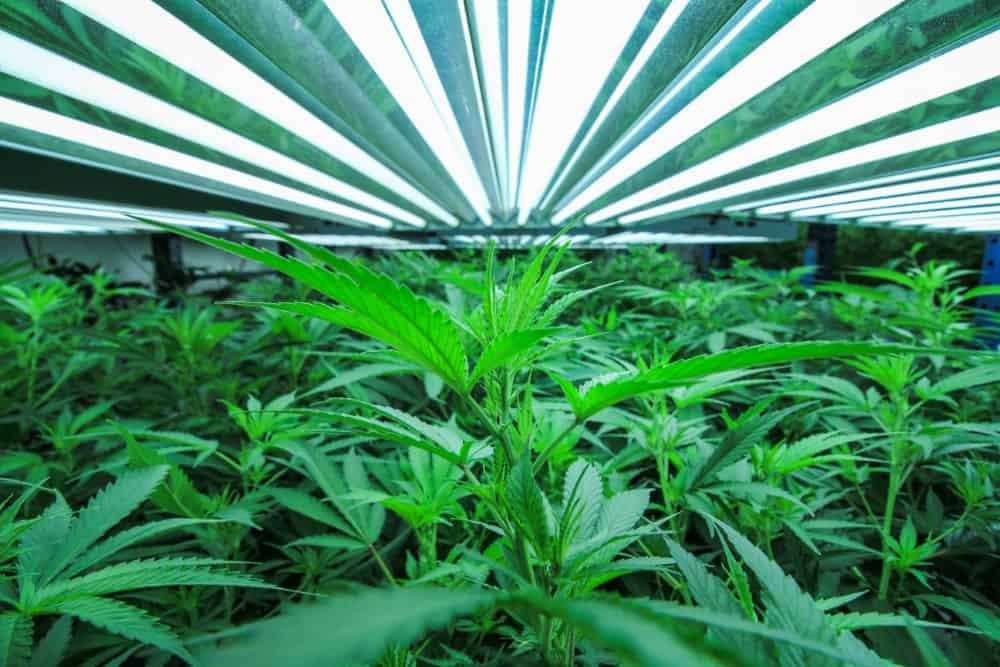
UPLUX 720 vs 840 LED Grow Light: Which Fixture Fits Your Grow?
Compare the UPLUX 720 and 840 LED grow lights by power, efficiency, controls, cooling and installation needs to choose the right fixture.

Full-spectrum and targeted-spectrum grow lights are often presented as opposing choices. In practice, commercial horticultural lighting is more nuanced: crop response depends on spectrum, photon quantity, distribution, photoperiod, environment and cultivar together. A strong fixture selection starts by separating what color the photons are from how many photons reach the canopy and how consistently they are delivered.
Photosynthetically active radiation (PAR) traditionally refers to photons from 400 to 700 nanometers. PAR is a range, not a measurement of fixture quality. PPF measures the total photosynthetic photons a fixture emits each second, while PPFD measures how many of those photons arrive on each square meter of canopy per second. Virginia Tech’s guide to PPFD and daily light integral provides a practical explanation of these plant-relevant units.
Spectrum describes the relative distribution of photons across wavelengths. Two lights can have similar PPF but different spectra, or similar-looking spectra but very different PPFD maps. A buyer should therefore assess spectrum alongside photon efficacy, canopy distribution and the intended daily light integral—not use the phrase “full spectrum” as a substitute for technical data.
In the commercial market, full spectrum usually describes a broad output containing useful photon energy across much of the visible range. It does not mean that every wavelength is present at equal intensity, nor that the fixture exactly reproduces sunlight. White LEDs commonly provide a broad base, with selected red or other emitters added to shape the horticultural spectrum.
A peer-reviewed review of LED efficacy from physics to horticultural fixtures explains why red, blue, white and far-red emitters involve both biological and electrical tradeoffs. It also shows why matching only the chlorophyll absorption peaks is an incomplete way to evaluate whole-canopy lighting.
Targeted-spectrum lighting emphasizes selected wavelength bands for a defined purpose. A fixture might use a red-and-blue combination as its primary output, enrich a broad spectrum with deep red, or add a separate supplemental wavelength. Targeting can be useful when the crop response, production stage and background light are understood. It is not automatically more efficient or more productive: the diode mix, driver, optics and operating point still determine fixture PPE, while the crop and environment determine the biological response.
| Approach | Potential advantage | Important limitation |
|---|---|---|
| Broad/full spectrum | Flexible use, comfortable crop inspection and broad wavelength coverage | The label alone reveals neither PPE nor canopy-level PPFD |
| Red/blue dominant | Can use electrically efficient diode channels and shape plant morphology | Crop response depends on the red/blue ratio, intensity, species and environment |
| Supplemental wavelength | Lets a grower address a specific photobiological or production objective | Requires a defined dose and evidence for the crop; more is not automatically better |
Plants use light both as energy for photosynthesis and as information that regulates form and development. The effects are interactive rather than isolated:
This is why a universal “best spectrum” does not exist for every crop, stage and facility. A spectrum that supports one production objective can produce an unwanted morphology in another. Avoid claims that a color recipe guarantees yield.
A technically impressive spectrum cannot compensate for insufficient intensity, poor uniformity or the wrong photoperiod. Evaluate the complete delivery system:
The UPLUX grow room lighting design guide covers mapping, spacing and overlap. For purchasing metrics and operating-cost factors, use the professional LED grow light buyer’s guide.
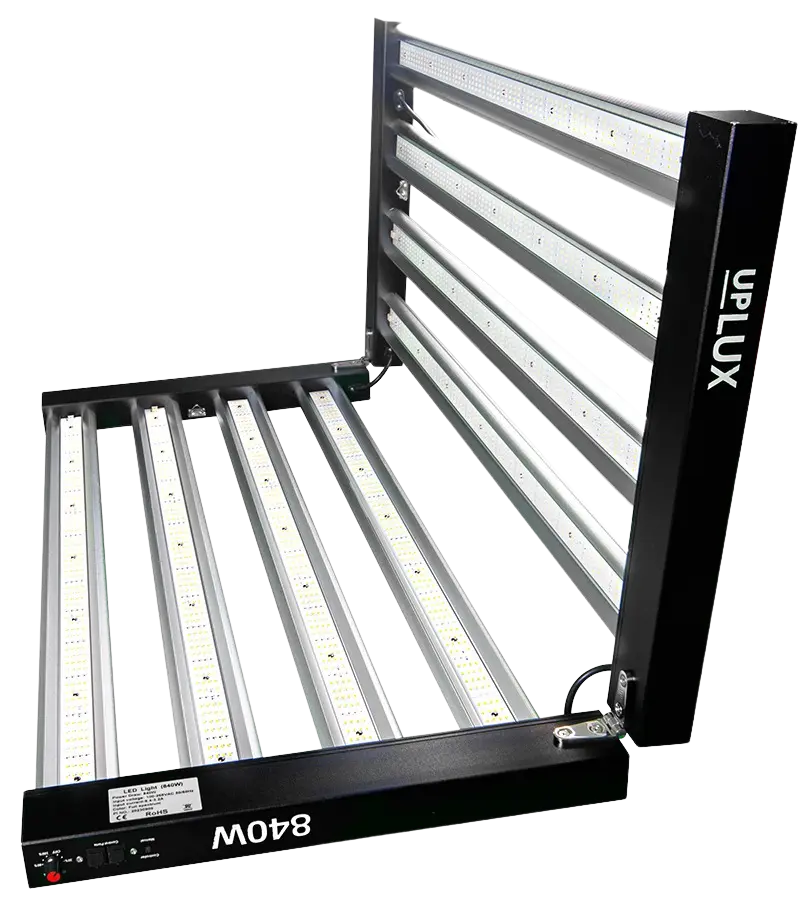
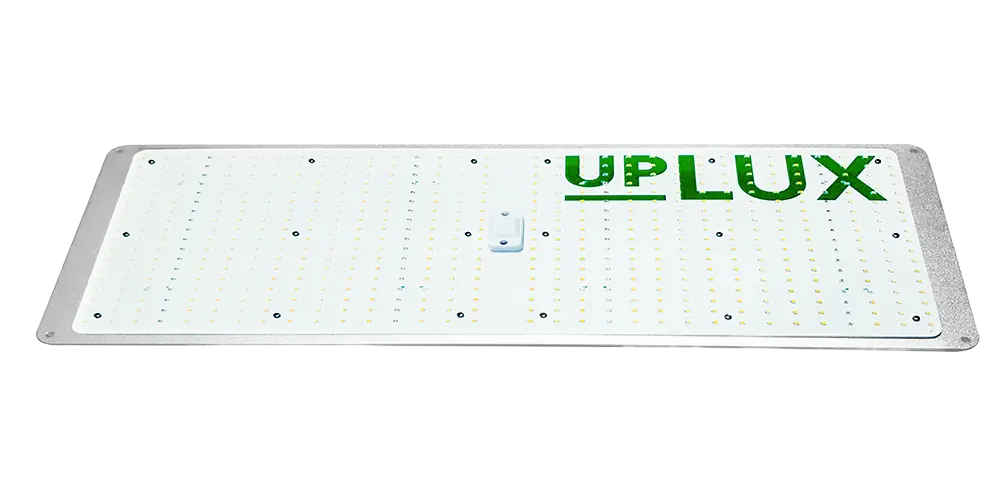
The UPLUX range provides several distinct architectures rather than pretending one fixture fits every installation:
For a new project, document the crop, stage, canopy, background sunlight, visual-inspection needs and desired control approach. Then compare measured spectrum, PPE and PPFD distribution together. UPLUX can help you identify the appropriate fixture class and current technical documentation. Explore the UPLUX grow light range or contact the team for a commercial project discussion.
Compare the UPLUX 720 and 840 LED grow lights by power, efficiency, controls, cooling and installation needs to choose the right fixture.
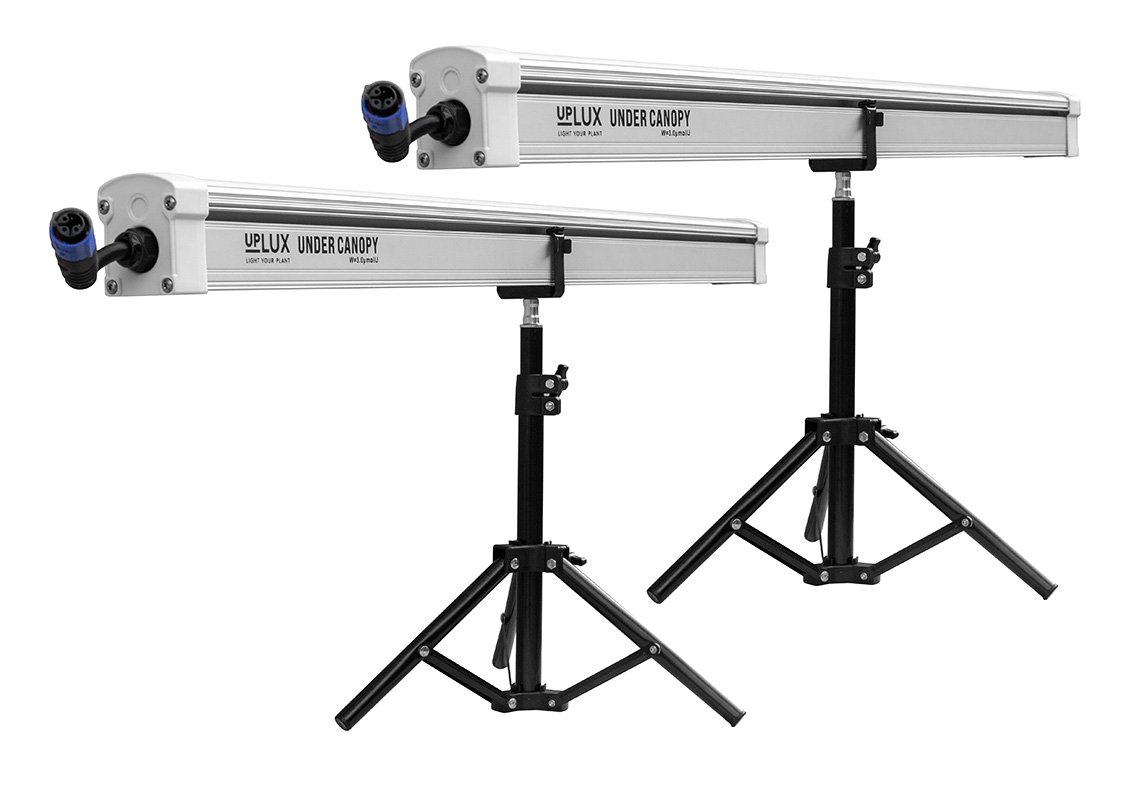
UPLUX under canopy grow lights deliver targeted illumination to lower plant zones, eliminating larf and boosting bud density for higher yields.
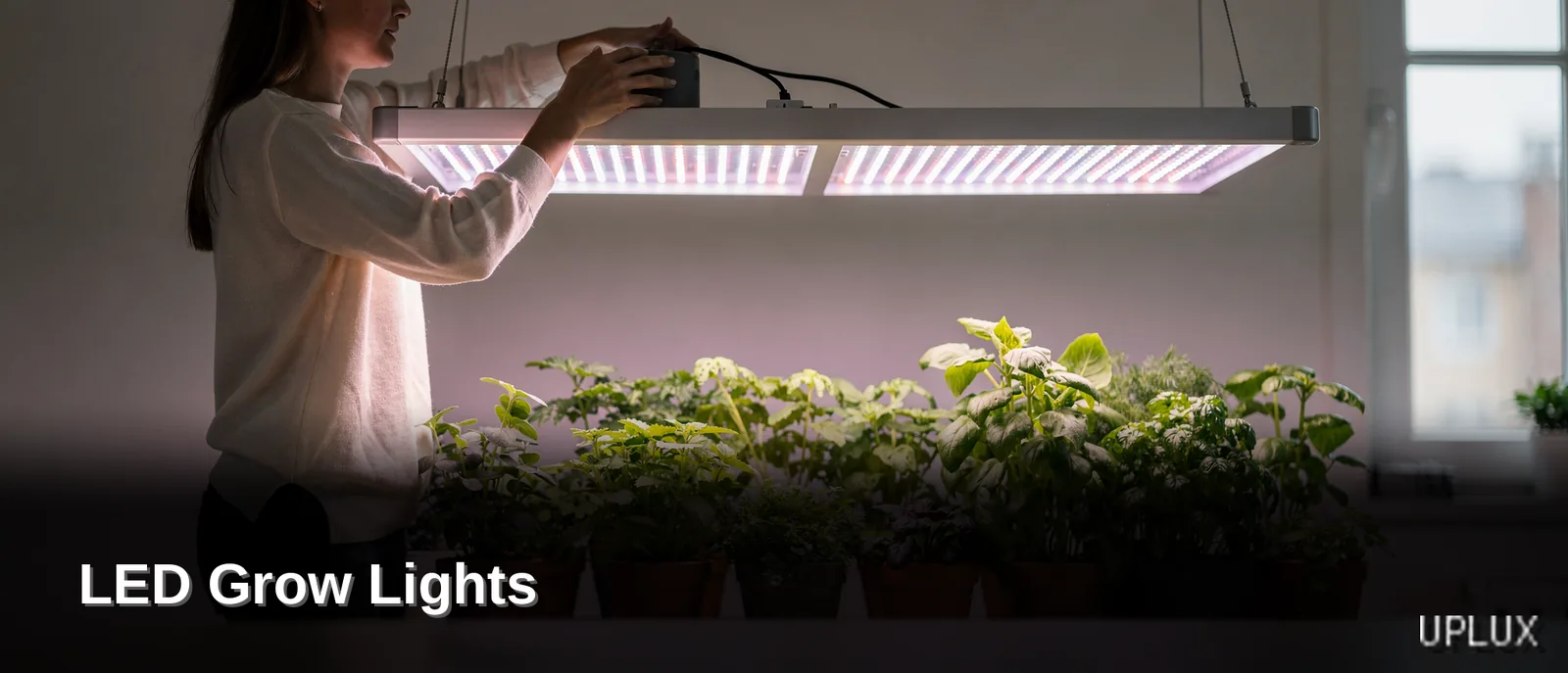
Learn how to compare LED grow lights by PPF, PPFD, PPE, spectrum, form factor, controls and operating cost—and explore verified UPLUX fixtures.