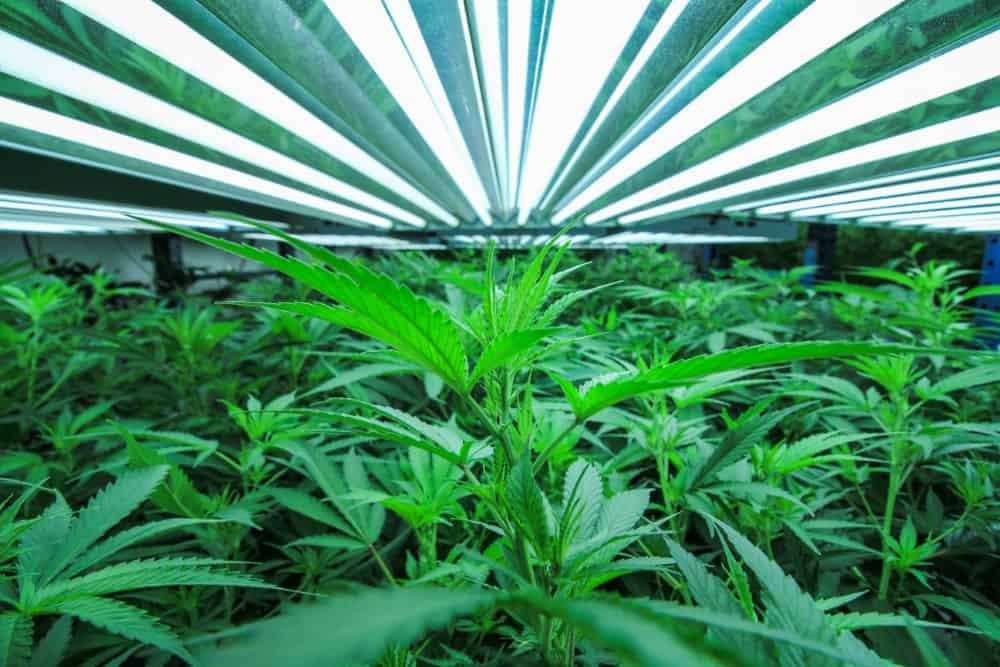
UPLUX 720 vs 840 LED Grow Light: Which Fixture Fits Your Grow?
Compare the UPLUX 720 and 840 LED grow lights by power, efficiency, controls, cooling and installation needs to choose the right fixture.

Choosing professional LED grow lights is a system-design decision, not a contest to find the highest wattage or the largest headline number. A commercial fixture must deliver the right quantity of photons to the crop, distribute them evenly across the working canopy, integrate with the facility’s electrical and control infrastructure, and remain practical to operate over many production cycles. This guide gives buyers a disciplined way to compare those factors without relying on vague coverage claims or unverified return-on-investment promises.
Define the production requirement before shortlisting luminaires. Record the crop and growth stage, finished canopy dimensions, target photoperiod, available mounting height, aisle and rack geometry, environmental limits, input voltage, control method and any certification requirements for the market. Greenhouse projects must also account for sunlight and seasonal daily light integral (DLI); sole-source indoor rooms must supply the planned light dose electrically.
A fixture that performs well in isolation can still produce a weak installation if its beam distribution, spacing or mounting height does not suit the room. Build the plan around a representative PPFD map and the actual canopy. Our guide to commercial grow room lighting design explains that layout process in detail.
Professional horticultural lighting is specified in plant-relevant photon metrics. Virginia Tech’s guide to PPFD and daily light integral provides a practical explanation of the units and calculations. Each metric answers a different buying question:
| Metric | What it measures | What it tells a buyer |
|---|---|---|
| Input power (W) | Electrical power consumed by the fixture | Electrical and heat-load planning; it is not a measure of plant light output |
| PPF (µmol/s) | Total photosynthetic photons emitted each second | Overall photon output before room layout and canopy capture are considered |
| PPE (µmol/J) | PPF delivered per joule of electrical energy | Fixture-level conversion efficiency |
| PPFD (µmol/m²/s) | Photosynthetic photons arriving at a surface each second | Intensity and distribution at crop level |
| DLI (mol/m²/day) | Accumulated photosynthetic photons over a day | The relationship between PPFD and photoperiod |
PPF and PPE help compare fixtures, but neither proves that a layout will illuminate a canopy uniformly. PPFD must be evaluated across a grid, not at a single center point. DLI then connects that measured intensity to operating time. Spectrum also matters: two fixtures with similar PPF can produce different crop responses and different working conditions. See the UPLUX guide to full-spectrum and targeted-spectrum horticultural lighting.
Coverage should never be inferred from wattage alone. Ask for a PPFD map that states the test height, test area and measurement grid. Review the average, the lowest readings, edge falloff and the difference between the center and perimeter. A very high central value can coexist with dark edges, and a quoted footprint can conceal poor uniformity.
In multi-fixture rooms, overlapping footprints are part of the design. The goal is a predictable canopy-level result across the operating area, including borders and transitions—not an impressive reading directly below one fixture. Bar-style luminaires can be valuable here because their emitting area spreads photons across the fixture footprint. Mounting height, reflectivity, structural obstructions and neighboring fixtures still determine the final map.
Almost all electrical input ultimately becomes heat inside the facility, even when an LED fixture is highly photon-efficient. Compare passive or active cooling design, required clearances, ambient operating conditions and the effect on HVAC or greenhouse ventilation. Passive cooling can reduce moving parts and routine fan maintenance, but the room still needs a heat-load plan.
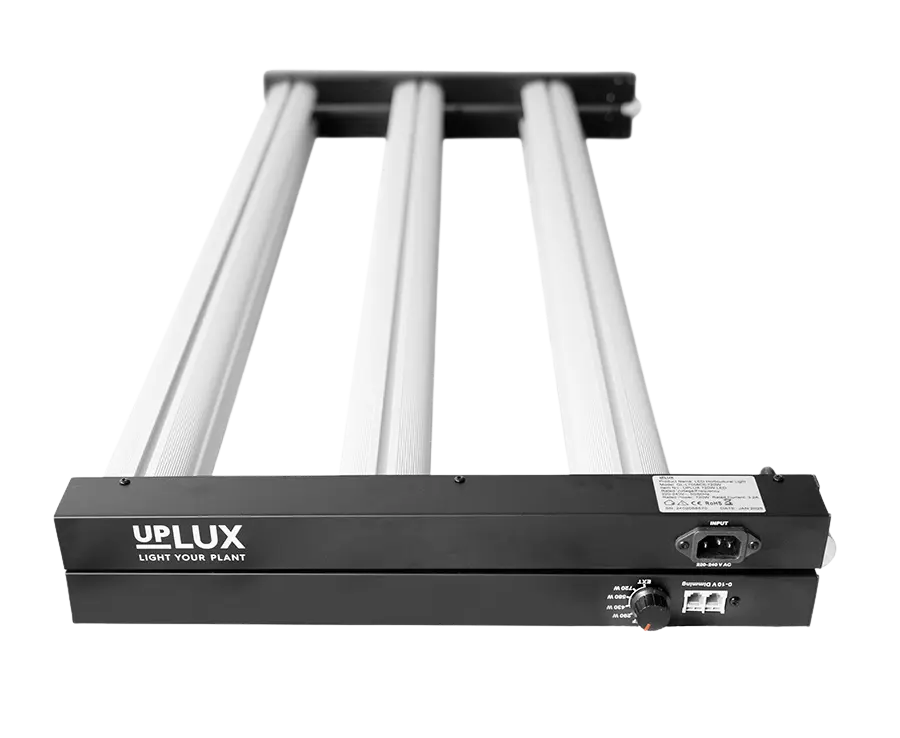
Confirm input-voltage compatibility, per-fixture current, connector and cable requirements, continuous circuit loading, switching strategy and local electrical-code obligations. The UPLUX 720 Spider supports 110–277 VAC and uses a built-in driver, giving designers flexibility across common commercial supply environments. Final circuit sizing and installation should always be completed by a qualified professional using the current product documentation.
Dimming is useful for commissioning, crop-stage changes, daylight-responsive greenhouse operation and managing environmental load. Verify the control protocol and fixture compatibility rather than assuming every 0–10V device will operate identically. The UPLUX 720 supports manual dimming and 0–10V control. For scheduled operation, the UPLUX controller guide covers centralized dimming, Auto Pilot schedules, sunrise/sunset ramping and temperature protection for compatible systems.
Certifications are not decorative badges. Determine which marks are required for the destination market, insurer, authority having jurisdiction or project specification, and ask for current documentation tied to the exact model. The UPLUX 720 and UPLUX Under Canopy 120W are documented with ETL, CE and UKCA certifications. Buyers should still verify that the supplied model and documentation match the project and local requirements.
Also assess suspension hardware, access for cleaning, cable routing, controller placement, spare-unit strategy and the labor required to service a fixture above a live canopy. These details often matter more to long-term operations than a small difference in purchase price.
Total cost of ownership (TCO) should be calculated from project-specific inputs:
Do not assign a generic payback period to every project. Energy tariffs, photoperiod, canopy capture, local climate, labor and existing infrastructure can change the result materially. Research by Nelson and Bugbee on greenhouse lighting economics reinforces a central procurement principle: fixture efficiency and effective photon capture at the canopy must be considered together.
| UPLUX solution | Verified strengths | Typical selection role |
|---|---|---|
| UPLUX 720 Spider | 720 W, 3.0 µmol/J PPE, six-bar design, 110–277 VAC, manual dimmer, 0–10V, built-in driver, ETL/CE/UKCA | Efficient professional overhead lighting where broad bar-style distribution and control are priorities |
| UPLUX 840 Spider Pro | 840 W, Top-Bin Samsung LEDs, passive thermal cooling, daisy-chain functionality and 1-year UPLUX commercial warranty | Higher-power commercial installations that prioritize output, passive cooling and scalable connection |
| UPLUX 240 Quantum | 240 W, 2.14 µmol/J PPE and documented SANAN/HPO/Nationstar LED sources | Compact rooms, benches and applications suited to a lower-power board-style fixture |
| UPLUX Under Canopy 120W | 120 W, 360 µmol/s PPF, 3.0 µmol/J PPE, 0–10V, 120–277 VAC, IP65, ETL/CE/UKCA | Supplementing shaded lower-canopy areas beneath the primary overhead system |
| UPLUX Controller | 0–10V/PWM control, Auto Pilot, daily/custom schedules, sunrise/sunset, temperature protection and support for up to 30 compatible fixtures | Centralized, repeatable operation of compatible UPLUX lighting installations |
UPLUX offers a compact range covering efficient overhead fixtures, a board-style option, lower-canopy supplementation and centralized control. For fixture selection, quantities or a commercial installation, contact UPLUX with your canopy dimensions, mounting height, supply voltage and cultivation goals. We can help identify the most relevant product path while you retain control of the final agronomic and electrical specification.
Compare the UPLUX 720 and 840 LED grow lights by power, efficiency, controls, cooling and installation needs to choose the right fixture.
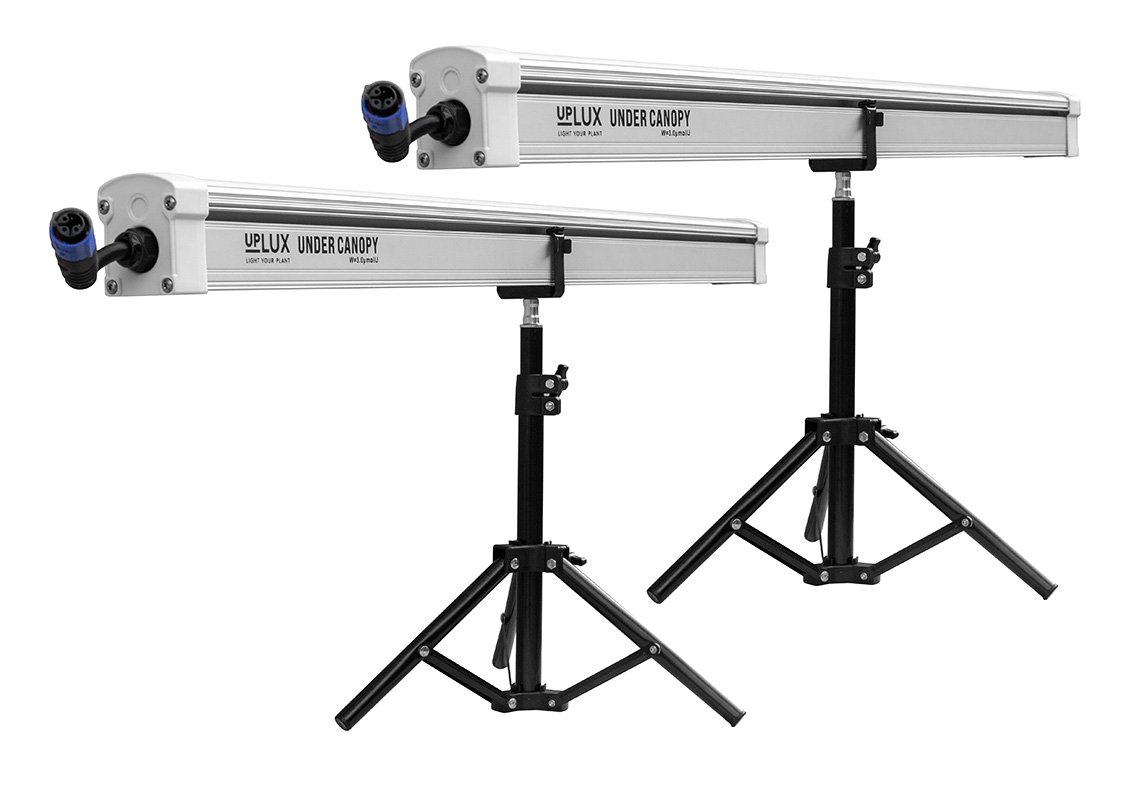
UPLUX under canopy grow lights deliver targeted illumination to lower plant zones, eliminating larf and boosting bud density for higher yields.
Learn how to compare LED grow lights by PPF, PPFD, PPE, spectrum, form factor, controls and operating cost—and explore verified UPLUX fixtures.