UPLUX 720 vs 840 LED Grow Light: Which Fixture Fits Your Grow?
Compare the UPLUX 720 and 840 LED grow lights by power, efficiency, controls, cooling and installation needs to choose the right fixture.

By UPLUX Editorial Team — Updated September 8, 2026
A 720 vs 840 LED grow light comparison is not simply a question of adding 120 watts. The UPLUX 720 Spider has a clearly documented efficiency, control and certification package. The UPLUX 840 Spider Pro is the higher-power option, with Top-Bin Samsung LEDs, passive cooling, daisy-chain capability and a 1-year UPLUX commercial warranty.
The practical answer is straightforward: choose the 720 when verified efficiency, broad input voltage and flexible dimming are central to the specification. Choose the 840 when the project deliberately calls for a higher-wattage fixture and values its thermal design, LED source, daisy-chain capability and warranty. More power is useful only when the canopy plan, electrical design and mounting conditions can use it.
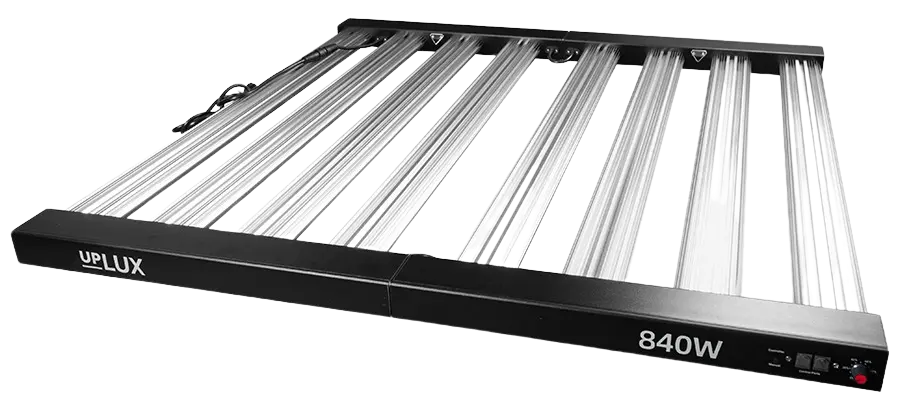
The nominal power difference is 120 W per fixture: 720 W versus 840 W. Across ten fixtures, that becomes 7.2 kW versus 8.4 kW of nominal lighting load—a 1.2 kW difference before any project-specific allowances. That matters to circuit planning, heat management and operating cost, but wattage alone does not prove canopy coverage or photon output.
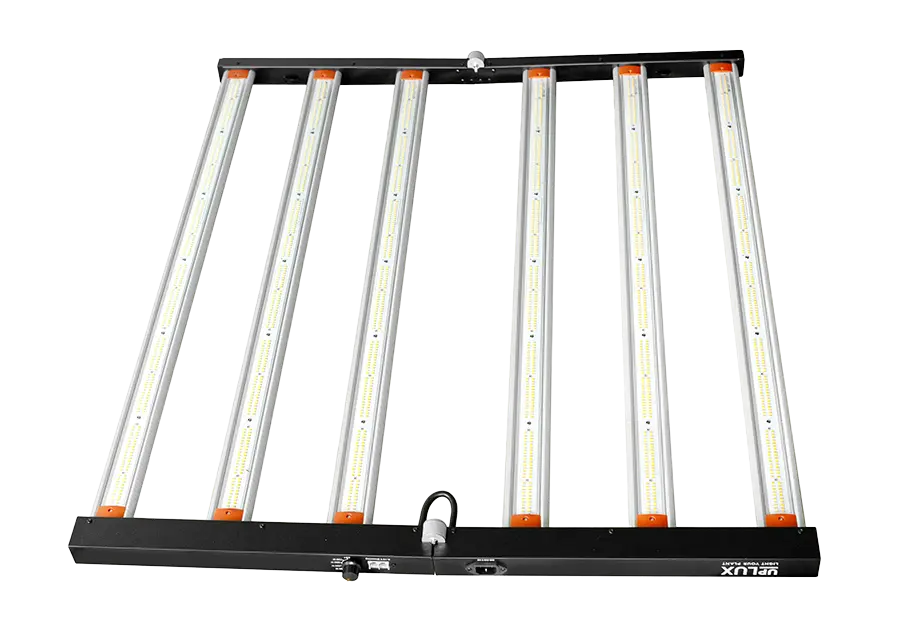
The UPLUX 720 combines a six-bar design with a verified PPE of 3.0 µmol/J, a built-in driver, manual dimmer and 0–10V control. Its documented input range is 110–277 VAC, and its verified approvals include ETL, CE and UKCA. The UPLUX 840 is defined by its higher 840 W input, Top-Bin Samsung LEDs, passive thermal cooling, daisy-chain capability and 1-year UPLUX commercial warranty.
Room size is only the starting point. A responsible fixture plan also needs canopy dimensions, target intensity, mounting height, bench or aisle layout, available voltage and the required uniformity. A 720 vs 840 LED grow light decision should therefore follow a PPFD layout at the intended installation height—not a generic “4 × 4” or “5 × 5” label.
The 720’s six-bar architecture distributes its emitting area across the fixture, while its manual dimmer and 0–10V input give the operator two documented ways to manage output. The 840 adds nominal power and brings a different commercial package: Top-Bin Samsung LEDs, passive cooling, daisy-chain capability and a 1-year UPLUX commercial warranty. The correct choice depends on which package fits the planned grid and operating method.
For multi-fixture rooms, use the UPLUX grow room lighting design guide to work from canopy maps, spacing and mounting height before fixing the final quantity.
The strongest verified efficiency statement in this comparison belongs to the UPLUX 720: 3.0 µmol/J PPE. UPLUX documentation currently contains conflicting PPF figures for the 840, so this article does not select one or use it to manufacture a comparison. The current figure should be confirmed with UPLUX before the 840 is specified for a project.
Wattage describes electrical input. It does not, by itself, describe the spectrum, photon output or distribution across a canopy. That is why the earlier “Which Spectrum Wins” framing was misleading: a useful comparison needs the current spectral file, a reliable output figure and a PPFD map at the proposed height.
If you need a refresher on PPF, PPFD, PPE and spectrum, the UPLUX LED grow light guide explains how the metrics work together. For procurement decisions, the commercial buyer’s guide shows how to compare them with controls, certifications and total operating cost.
The 840 draws 120 W more nominal power per fixture. That difference compounds in a large array, so the lighting choice should be reviewed with circuit capacity, daily photoperiod and HVAC load. The 720 provides a documented 110–277 VAC range; the current electrical specification for the 840 should be confirmed before circuit design.
The 720 includes a built-in driver, manual dimmer and 0–10V control. The 840 provides daisy-chain capability and passive cooling. These are different practical strengths: one gives the project clearly documented control and input options; the other supports linked installation planning and passive thermal management.
If centralized operation is required, review the UPLUX Controller and confirm compatibility for the exact fixture revision before ordering. Control cabling, fixture count and daily schedules should be defined alongside the lighting layout.
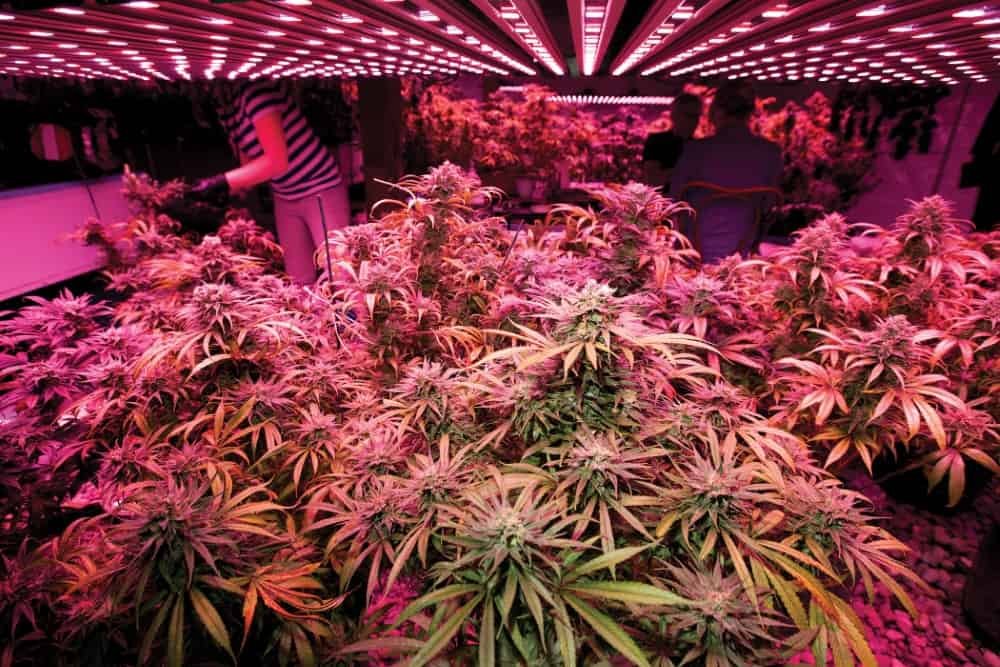
This checklist prevents a common buying error: selecting a fixture from wattage alone and trying to make the room fit it afterward. Start with the crop and facility, then select the fixture that makes the complete plan easier to operate.
The UPLUX 720 is the clearer choice when the decision depends on verified efficiency, flexible dimming, broad documented input voltage and named certifications. Its 3.0 µmol/J PPE, six-bar design, 0–10V control, manual dimmer, built-in driver and ETL/CE/UKCA package give a buyer concrete data to specify.
The UPLUX 840 is the stronger choice when the project intentionally needs the higher-wattage option and prioritizes Top-Bin Samsung LEDs, passive cooling, daisy-chain capability and a 1-year UPLUX commercial warranty. Confirm the current PPF and project-specific electrical details before the fixture count and spacing are finalized.
Not sure which fixture fits your project? Send UPLUX your canopy dimensions, mounting height, supply voltage and control requirements. The team can help match the product to the room instead of forcing the room around a headline wattage.
Compare the UPLUX 720 and 840 LED grow lights by power, efficiency, controls, cooling and installation needs to choose the right fixture.
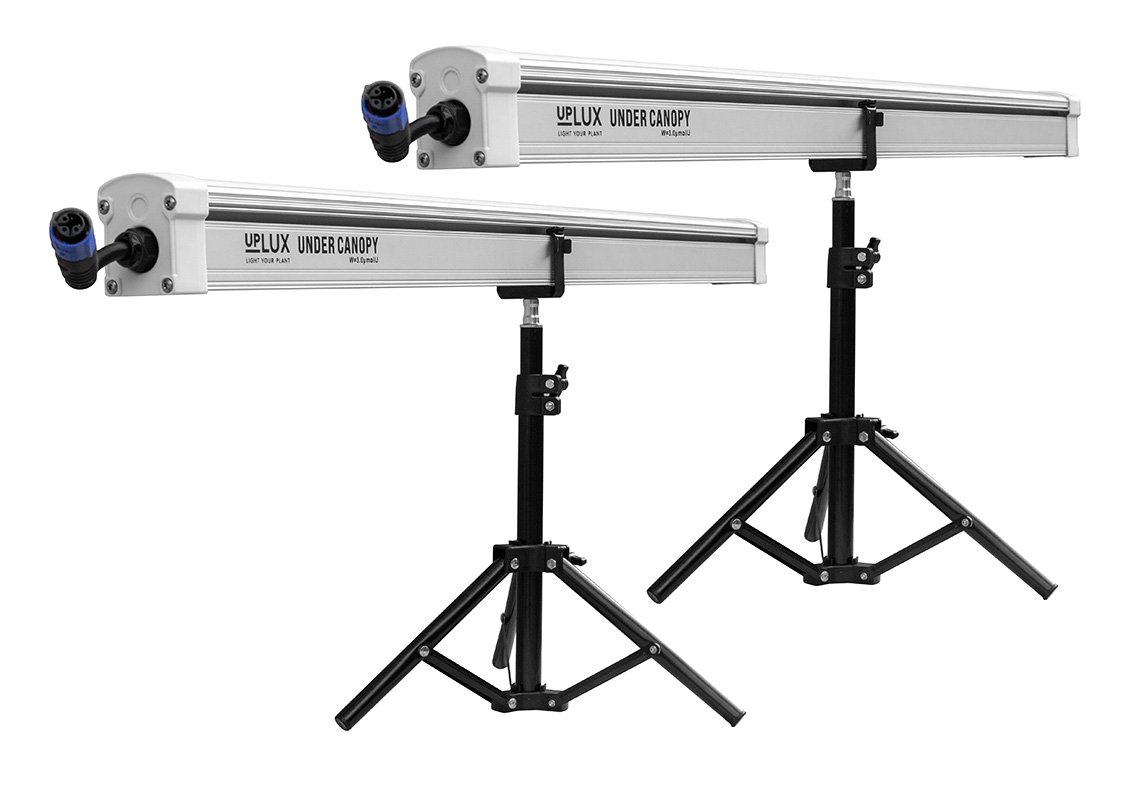
UPLUX under canopy grow lights deliver targeted illumination to lower plant zones, eliminating larf and boosting bud density for higher yields.
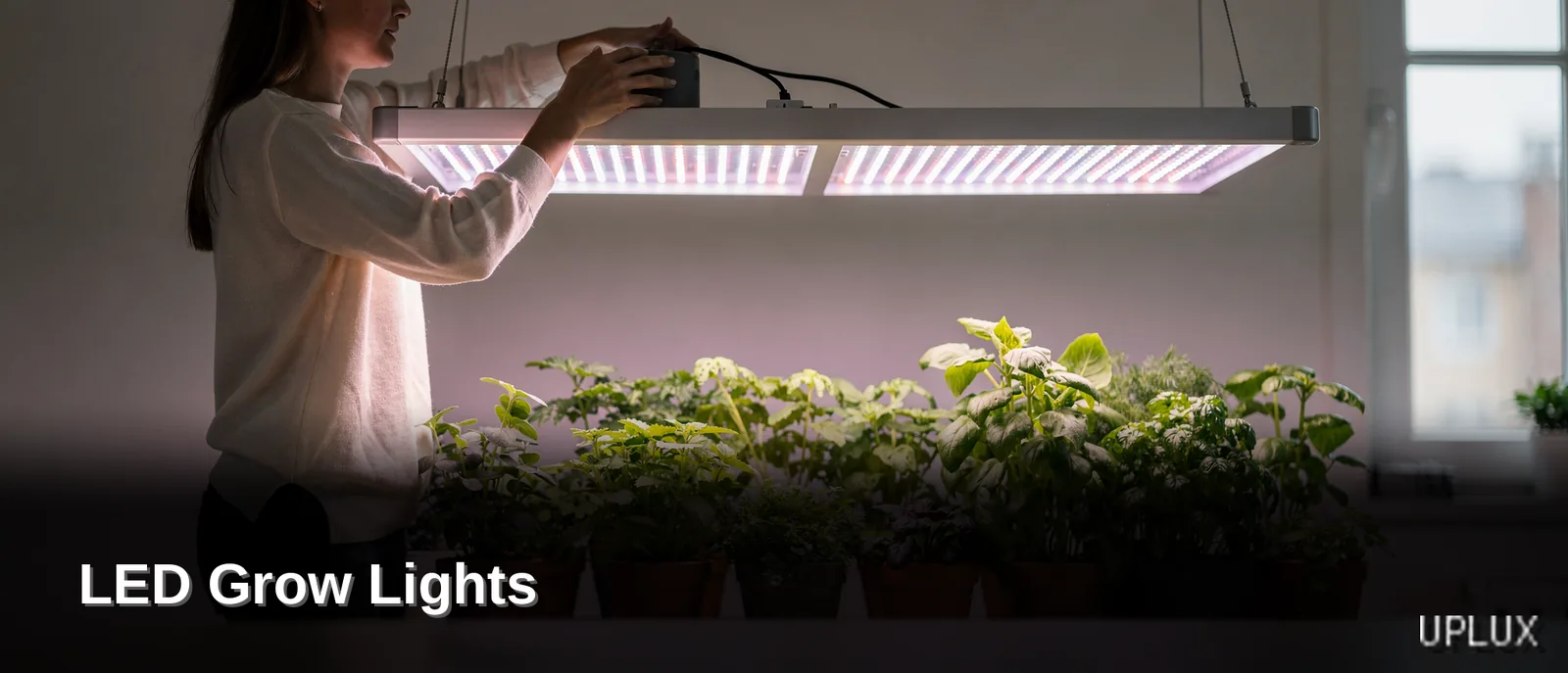
Learn how to compare LED grow lights by PPF, PPFD, PPE, spectrum, form factor, controls and operating cost—and explore verified UPLUX fixtures.