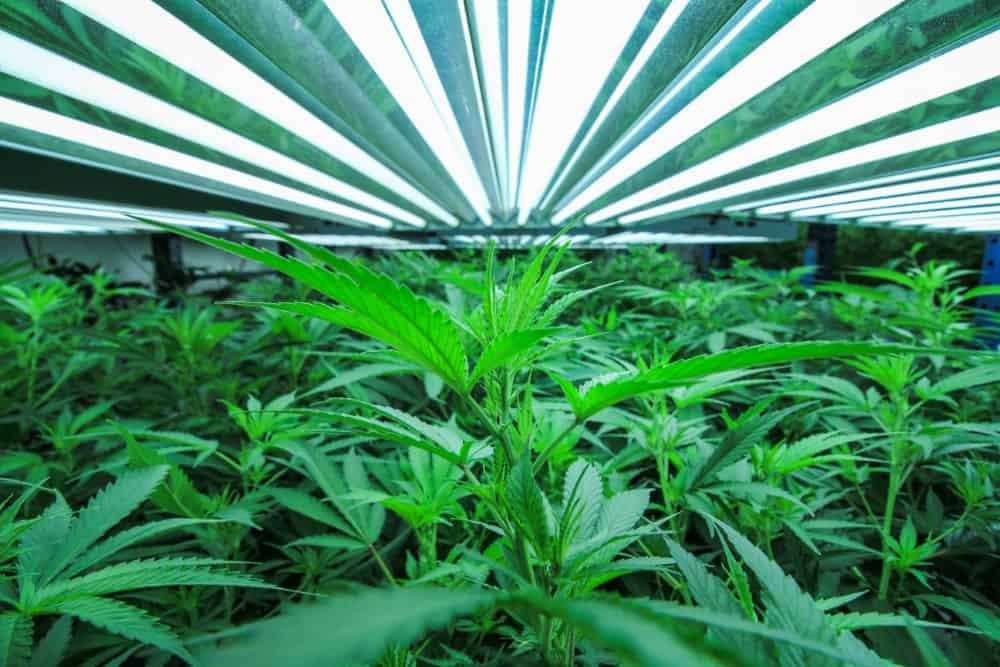
UPLUX 720 vs 840 LED Grow Light: Which Fixture Fits Your Grow?
Compare the UPLUX 720 and 840 LED grow lights by power, efficiency, controls, cooling and installation needs to choose the right fixture.

A quantum board grow light uses a flat circuit-board format populated with many LEDs across a broad emitting surface. The architecture can deliver useful canopy coverage from a compact, low-profile fixture, but the phrase “quantum board” is not a performance rating. Buyers still need verified input power, photon efficacy, spectrum, thermal design and PPFD data for the exact product.
In common horticultural use, a quantum board is a printed circuit board carrying a distributed array of LEDs. Rather than concentrating light in one lamp or a small number of modules, the diodes are spread across the board. The board is mounted to a heat-spreading structure and paired with an LED driver.
That layout can provide three practical advantages:
These are architectural benefits, not automatic promises of uniformity, efficiency or lifetime. Diode selection, drive current, board area, heat transfer and mounting height determine the result.
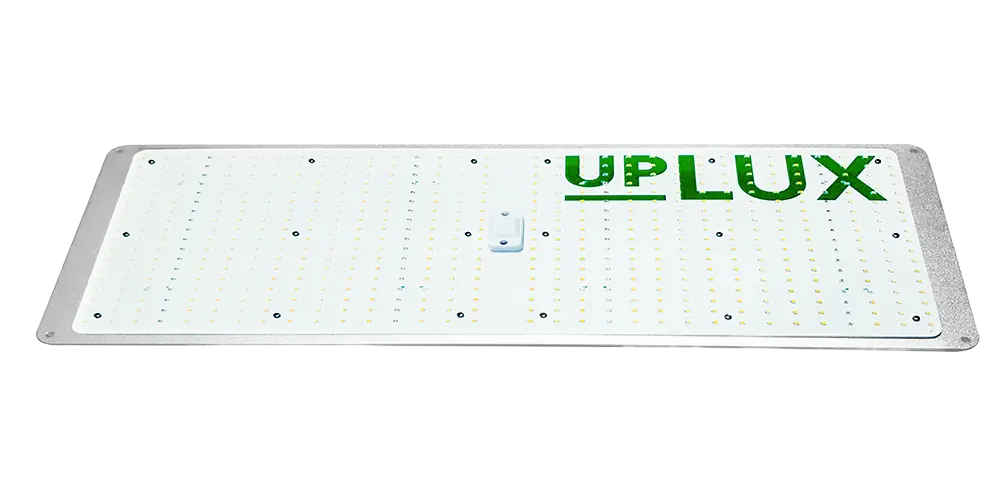
Spreading emitters across a board increases the apparent source area. At an appropriate mounting height, the individual emission patterns overlap and create a more useful canopy footprint. Move the fixture closer and peak PPFD usually rises while the footprint narrows; move it higher and distribution generally broadens while intensity falls. Reflective walls, neighboring fixtures and the canopy itself also affect measured results.
For that reason, a single center reading is not enough. Review a full PPFD map at the proposed height, including corners and edges, then measure the installed system on a representative grid. The UPLUX grow room lighting design guide provides a practical mapping workflow.
Board-style fixtures commonly combine white and selected horticultural LEDs to create a broad spectrum. Full spectrum does not mean that all wavelengths are equal or that every broad-spectrum fixture is suitable for every crop. Spectrum must be considered with intensity, photoperiod, cultivar and environment.
Red, blue and green photons all contribute to photosynthesis within the traditional 400–700 nm PAR waveband, while specific wavelength balances also influence plant form. A peer-reviewed study of white versus blue-plus-red LED radiation demonstrates that spectral choice involves tradeoffs among plant growth, visual quality and fixture PPE. The practical conclusion is not that one color mix always wins—it is that buyers should compare measured spectra and crop objectives.
For a deeper explanation, read full-spectrum vs targeted-spectrum horticultural lighting.
The UPLUX 240 Quantum is the UPLUX implementation of this board-style architecture. Its approved data supports:
The UPLUX 240 should not be described as a Samsung fixture. Samsung LEDs are a verified feature of the higher-power UPLUX 840 Spider Pro, not the 240 Quantum. Keeping those product architectures separate gives buyers a clearer basis for comparison.
A compact 240 W fixture can be a strong choice when the room, bench or rack does not require a high-power overhead luminaire. Typical evaluation scenarios include compact controlled-environment rooms, propagation or vegetative benches, research areas and modular installations where several smaller fixtures provide more layout flexibility than one large source.
Suitability still depends on the measured canopy requirement. Do not assume that every 240 W board covers the same area or belongs at a fixed universal height. Use the product’s data, the actual canopy dimensions and a representative PPFD grid.
| Design factor | Board-style fixture | Bar-style fixture |
|---|---|---|
| Emitting area | Diodes distributed across one or more flat boards | Diodes distributed along separated bars |
| Physical format | Compact and low profile | Broader frame can span more of the canopy |
| Layout use | Useful for smaller footprints and modular arrangements | Strong option for larger overhead footprints and overlapping commercial grids |
| Selection evidence | Compare PPE, spectrum, PPFD map, mounting height, thermal design, controls and electrical requirements for the exact model | |
For higher-power bar-style applications, the UPLUX 840 Spider Pro uses Top-Bin Samsung LEDs and passive thermal cooling, while the UPLUX 720 uses a six-bar design with verified 3.0 µmol/J PPE. Architecture should follow the canopy and project requirement rather than fashion.
The professional LED grow light buyer’s guide explains how to compare PPE, PPF, controls and operating costs across fixture types.
For compact, professional horticultural lighting, view the verified specifications and current availability of the UPLUX 240 Quantum. For quantities or help matching a fixture to a room, contact UPLUX.
Compare the UPLUX 720 and 840 LED grow lights by power, efficiency, controls, cooling and installation needs to choose the right fixture.
UPLUX under canopy grow lights deliver targeted illumination to lower plant zones, eliminating larf and boosting bud density for higher yields.
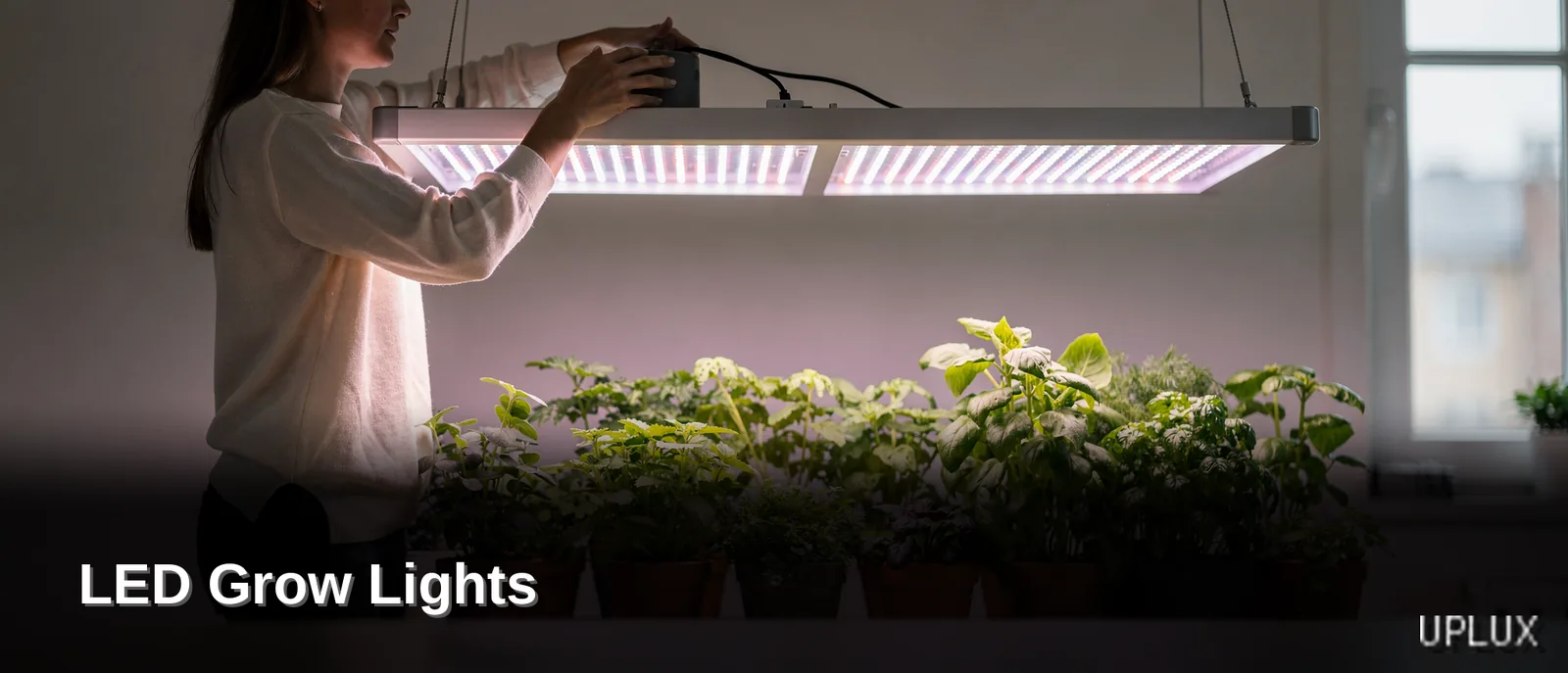
Learn how to compare LED grow lights by PPF, PPFD, PPE, spectrum, form factor, controls and operating cost—and explore verified UPLUX fixtures.